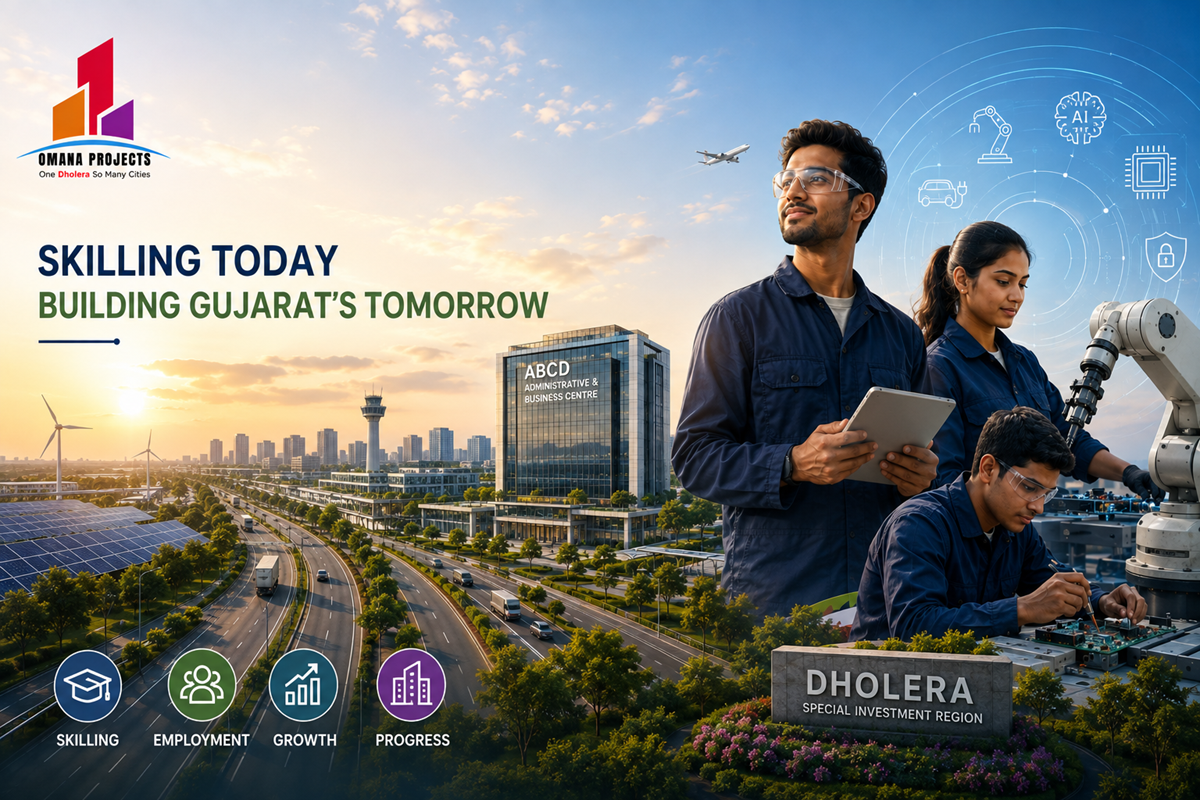
Namo Gujarat Kaushalya And Rozgar Mission
Namo Gujarat Kaushalya & Rozgar Mission: Building the Talent Pipeline for Gujarat's Industrial Future
Introduction
Gujarat's industrial ambitions have never lacked capital or policy support — what has historically been harder to secure at scale is a workforce trained specifically for the technologies these projects actually need. That gap is exactly what the state's newly launched Namo Gujarat Kaushalya and Rozgar Mission (NGKRM) is designed to close. On August 13, 2026, the Gujarat Government confirmed that more than 250 industries and academic institutions have already responded to its call to become training partners under the mission, as the state sets out to skill 1.03 lakh candidates during 2026-27. For a region like Dholera SIR, where industrial investment has been arriving faster than the local workforce has been able to keep pace, this mission is one of the more directly consequential policy moves of the year.
What Is the Namo Gujarat Kaushalya and Rozgar Mission?
NGKRM is a flagship initiative under Gujarat's Labour, Skill Development and Employment Department, run through the Directorate of Skill Development and the Gujarat Skill Development Mission (GSDM). Its core purpose is to build an industry-aligned skilling ecosystem — training people specifically for the roles that Gujarat's expanding manufacturing and technology sectors are actually hiring for, rather than generic vocational education disconnected from real demand.
The mission's flagship training component is the Gujarat Institutes for Advanced Skills (GIAS), and it was under this component that the Directorate of Skill Development issued its Expression of Interest (EOI) inviting industries, academic institutions, and training providers to empanel as official Training Partners.
Who's Already On Board
The response has been substantial. Confirmed training partners and participants include:
- L&T (Larsen & Toubro), a major infrastructure and engineering conglomerate with active interests across Gujarat's industrial corridors
- International Automobile Centre of Excellence (iACE), specializing in automotive and EV-related technical training
- Tata Indian Institute of Skills, extending the Tata Group's skilling infrastructure into the mission
- Ganpat University, bringing academic-sector training capacity into the fold
In total, more than 250 industries and academic institutions have submitted proposals — a scale of industry buy-in that signals genuine private-sector confidence in the mission's design, not just government messaging.
The Numbers Behind the Mission
- 1.03 lakh youth targeted for skill training during 2026-27
- 250+ industries and academic institutions confirmed as training partners
- 12 emerging technology domains form the training focus, including Artificial Intelligence, Robotics, Semiconductors, Electric Vehicles (EVs), Cybersecurity, and Drones, among others
- Free training for eligible candidates
- ₹500 incentive for every 120 hours of training, disbursed via Direct Benefit Transfer (DBT) after certification
- A long-term goal of training 5 lakh people every year, positioning NGKRM as an ongoing structural program rather than a one-time skilling drive
Why This Matters Specifically for Dholera
Skill development announcements at the state level don't always translate into visible, local impact — but Dholera SIR is arguably the single clearest beneficiary of this particular mission, for a straightforward reason: its industrial ecosystem is scaling faster than most regions in India right now.
The Semiconductor and Industrial Buildout Needs Skilled Hands
Dholera's growing footprint of anchor investment — including major semiconductor manufacturing capacity and an expanding cluster of ancillary industrial partners — depends on a locally available, technically trained workforce to actually staff these facilities once they come online. NGKRM's focus on semiconductors, robotics, and AI as named training domains lines up directly with the skill sets Dholera's industrial employers will be recruiting for over the next several years.
Skills + Industry + Infrastructure
The mission's own framing captures the logic well: skills, industry, and infrastructure reinforce each other. Dholera already has two of the three pieces well underway — infrastructure investment and industrial anchor commitments. A dedicated, state-backed skilling pipeline is the piece that ensures the jobs these investments create can actually be filled by the local and regional workforce, rather than requiring imported labor at scale.
A Long-Term Signal, Not a One-Off Scheme
The stated goal of training 5 lakh people annually suggests NGKRM is intended to function as permanent workforce infrastructure for Gujarat's industrial corridors — Dholera included — rather than a short-term political announcement. For a region planning multi-decade growth, that kind of sustained commitment matters more than a single training batch.
What This Means for Investors and Residents Watching Dholera
For anyone tracking Dholera's growth story — whether evaluating residential, industrial, or mixed-use plots in the region — a credible, well-funded skilling mission is a meaningful indirect signal. Employment-driven demand for housing, retail, and services typically follows workforce growth closely, and a structured pipeline like NGKRM reduces one of the more commonly cited risks in fast-growing industrial regions: a shortage of locally available skilled labor slowing down industrial ramp-up.
Leave a Comment
No comments yet. Be the first to comment!